Tuesday, June 4, 2024

Dana Frank provides a necessary introduction to understanding political strikes


The Labor and Working Class History Association has published a thorough and very helpful essay by labor scholar Dana Frank on political strikes. Sister Frank takes the current strike underway among graduate students at the University of Californmia as her point of departure. A link to the entire article is below.

UC Graduate Workers and the History of Political Strikes

On Wednesday, May 15, 79% of 48,000 graduate student workers at the University of California who cast their ballots voted to authorize a strike. Their demands include UC divestment from weapons manufacturers and contractors who profit from the Israeli war on Gaza, protection of campus free speech in the aftermath of police repression at UCLA and amnesty for those facing discipline for protesting. Members of the United Auto Workers, the graduate students have launched a sequence of selected strikes targeting different campuses. They began on Monday, May 20, with UC Santa Cruz, where 1,500 members have walked out, and where I taught labor history for 27 years. On May 28 graduate workers at UC Davis and UCLA joined them, and other campuses appear to be joining soon. This is a big strike, with big import for both the solidarity movement with Palestinians, and for the labor movement.

For some observers, the graduate workers’ objectives can appear far away from what are commonly understood to be the function of labor unions such as addressing concerns about pay, working conditions, or vacations. But what are known as “political strikes” have a long, creative, and often powerful history in the United States. Today’s UC strikes, smack in the middle of a national uprising protesting US support for the Israeli government’s genocide in Gaza, challenge us to think more flexibly about what a labor movement is, and can be, today–and its relationship to broader demands for social justice.

Members of the International Longshoremen’s International Union (ILWU) are famous, for example, for refusing to load cargo in solidarity with resistance movements overseas–to Franco’s Spain, to South Africa under Apartheid, to Chile under Pinochet. Most recently, on Juneteenth 2020 they joined Black Lives Matter in a mass national protest against racist police repression and shut down all the ports on the West Coast.

In many political strikes, union members have walked out as part of a broader national protest, as on Juneteenth. Some of these strikes have been officially sanctioned by unions; more often, workers simply walk out en masse. On May Day 2006 tens of thousands of Latinx and other workers simply skipped work to attend a national protest against a proposed repressive federal immigration law. Meatpacking plants shut down for the day rather than confront their workers. Port truckers in Long Beach and Los Angeles refused to load cargo. Over a million people came to demonstrations.

In 1963, A. Philip Randolph, president of the Brotherhood of Sleeping Car Porters, made sure that March on Washington for Civil Rights took place on a Wednesday, not on a Saturday. That way, things would be shut down… but not in an obvious way. Government workers just couldn’t get to work.


Robert Bruno and What Work Is---How do we think about work and workers?


From an essay by Robert Bruno on the Labor & Working-Class History Association website:

In my book, What Work Is, I assert that work has an enormous contradictory impact on the workers and society they build. Anthropologist Herbert Applebaum draws on a biological metaphor to centralize the importance of work to the individual and society. Work, he notes, “is like the spine which structures the way people live, how they make contact with material and social reality, and how they achieve status and self-esteem.”[1] There’s much that makes us human, but work—fully understood—is critical to our individual and social development. Society itself emanates from how we make, distribute, and use the products of our collective labor. Karl Marx stated it as an immutable law that “Labor … is the condition of human existence which is independent of all forms of society.” It is an “eternal and natural necessity which mediates … life itself.”[2]

As the United States struggles with an unchartered and unprecedented change in how people will work and think about work, my book recommends a “future of work” that listens to what workers say, “work is.” The thesis of the book is that as we formulate new work structures, we should draw from what workers have appropriated from their work experiences. My intention is that we first learn from what workers can tell us about their present work to know how to design a future of what work should be.

The voices of workers should be prioritized in developing public policies and workplace practices that endeavor to make work more respectful of human life and harmonious with the natural and social world. What workers tell us about “what work is” should inform how leaders of political, business, labor, educational, media and cultural institutions think about the ubiquitous act of working for a living. The reality of work won’t be changed unless we recognize what a complicated, contradictory, glorious, and poetic experience work is. To change what our society does with work and to workers requires first understanding how workers experience their labor. Listening to voices from the point of production is the beginning of thinking differently about work.

Read the entire essay here.

Unions Stand in Solidarity with Campus Protesters, Demand Their Rights to Protest and Free Speech Be Respected

For more information contact:

Jonathan Kissam, UE Communications Director
(802) 343 1745 | jkissam@ueunion.org


MAY 20, 2024

Unions representing over one million workers released a statement today in support of campus protesters at colleges and universities across the country.

The unions are members of the National Labor Network for Ceasefire (NLNC), which has been outspoken for an immediate ceasefire in Gaza, restoration of basic human rights, immediate release of the hostages, unimpeded full access for humanitarian aid, and our president calling for a permanent ceasefire.

The six national and four local unions, some of whom represent faculty, student, and other campus workers, are stepping forward because they recognize the risk of suppressing free speech — employers have been trying to suppress workers demanding their rights for centuries. When some campuses began enlisting police to beat and arrest protesters to silence them, the already unacceptable crackdowns across the country went too far.

Union members have been attacked by the police on some campuses for exercising their rights to free speech, assembly, and protest. Labor unions across the country must defend these rights as the same rights that sustain our democracy and provide a voice for workers,” says Carl Rosen, General President of the United Electrical Workers Union (UE).

Here is the full statement:

Unions Stand in Solidarity with Campus Protesters, Demand Their Rights to Protest and Free Speech Be Respected

Our unions, representing over one million union members, stand in solidarity with those students, faculty and other academic workers across the United States who have faced a repressive and violent crackdown of their protests of the war in Gaza. We demand that campus administrators cease their campaign of threats, suspensions and expulsions against peaceful protestors and cease using law enforcement agencies to disrupt and attack them.

Our unions are all members of the National Labor Network for Ceasefire, united by our shared call for a ceasefire in Gaza, the safe return of hostages, and safe passage for urgently needed humanitarian aid to those displaced, starved and injured by Israel’s campaign in Gaza. We see our demands broadly reflected in the campus protests.

Moreover, as trade unionists, we can never support efforts to repress, intimidate or deploy state-sanctioned violence against those exercising their democratic rights of free speech and who protest, strike, or demand justice.

The repressive response of certain university administrators and local police to these protests is also a labor rights issue. Faculty, student workers, and other campus workers – many of whom belong to our unions – are among those who have been arrested and forcibly removed from the protests or suspended from their work. University staff have been ordered to clear protests led by students, their fellow workers and union members. Academic freedom, free speech, the right to assemble, and the right to protest are fundamental rights and they must be respected on campuses and across the country.

The time for peace is now. We stand in solidarity with the protesters.

American Postal Workers Union (APWU)
Association of Flight Attendants (AFA-CWA)
International Union of Painters and Allied Trades (IUPAT)
National Nurses United (NNU)
United Auto Workers (UAW)
United Electrical Workers Union (UE)
Chicago Teachers Union Local 1 (CTU-1)
SEIU Healthcare Pennsylvania (SEIUHCPA)
1199SEIU United Healthcare Workers East (1199SEIU)
United Food and Commercial Workers Union, Local 3000 (UFCW 3000)


Two important solidarity actions with our region's farm workers

This important article from The STAND provides some needed context for the post below.


From the United Farm Workers:

Community support is crucial for the mushroom workers who filed a lawsuit against Windmill Farms, Sunnyside, Washington, last November. Please join the workers and United Farm Workers in front of the Yakima courthouse to show our support.

Date: Tuesday, June 11, 2024
Time: 2:00 p.m. RALLY in support of the workers; 3 pm hearing
Location: Yakima County Superior Court, 128 N 2nd St, Yakima, WA 98901

Summary of the Hearing:

The oral arguments will address two critical motions filed by Windmill/Greenwood:

1. Motion to Compel Arbitration: Windmill is seeking to move our case out of the public court system and into private arbitration.
2. Motion to Dismiss: Windmill has also filed a motion to dismiss our claims.

Why This Hearing Is Important

Company Violations: This case addresses violations of the Washington Little Norris-LaGuardia Act, including the unlawful terminations of prominent UFW supporters and other critical issues affecting worker rights.

Transparency: Keeping the case in the public court system ensures that the proceedings remain open and transparent, allowing for greater public scrutiny and accountability.

Justice for Workers: Dismissing the case at this stage would deny workers the opportunity to have their claims heard and adjudicated fully. We believe strongly in the merits of our case and in the importance of fighting for the rights of those who have been wronged.Solidarity: Your presence at the hearing will show solidarity with the affected workers and demonstrate to Windmill/Greenwood and the court that there is strong community support for holding the company accountable.
From the Rev. Connie Yost, President of Farm Worker Ministry Northwest and board member, National Farm Worker Ministry:

I recently had the privilege of speaking to members of the Yakima Association of Faith Communities, along with United Farm Workers activist Lorena and former Windmill employee Isela. Our goal was to raise awareness of farm worker issues, and to gather support for the Windmill Farms mushroom workers who are experiencing ongoing abuses in their workplace.

I urge all of you who are able to join us at the Yakima County Superior Courthouse at 2 pm on Tuesday, June 11 to show our solidarity and support for the workers.

Your support and action is something that is vitally needed. Farm workers too often feel all alone. Let's show them our love and support by being there for them.

Here are voices from the YAFC community:

Roger Yockey, Holy Family Catholic Church, Yakima: "Folks who are actively involved in the Yakima Association of Faith Communities can help our sisters and brothers who are farm workers by joining with them at rallies, peaceful protests to demand social and economic justice for the women and men who feed us. As a Christian, my faith speaks to me loud and clear to see what the situation is for workers, to judge what is happening, to pray, and then to act to change any unjust situation."

Marilyn Holloway, Bodhi Center of Yakima: "Whilst I have long been aware of the appalling conditions in which farm workers labor to put food on our tables, I was less aware of their efforts to unionize. I knew nothing about the Farm Worker Ministry Northwest and this organization's efforts to support the farm workers in their struggle for better working conditions and justice. I have also learned how I can support the farm workers, so now feel I can do something rather than being a helpless bystander."

The Rev. Connie Yost, introduction to the Prayer of the Farm Workers' Struggle, by Cesar Chavez

Martin Luther King Jr. spoke to the sanitation workers in Memphis just weeks before his assassination. These black workers were treated badly, forced to work in unsafe conditions for poverty wages. A worker had been crushed to death by a defective truck, and the mayor refused to discuss their wish for a union. Martin Luther King Jr. told them, and he reminds us, that All Labor Has Dignity. Today, farmworkers are in the same situation.

Let us pray the Prayer of the Farm Workers’ Struggle, by Cesar Chavez.

Read the latest news of the mushroom workers

Another Opportunity to Help Farm Workers

EMERGENCY BACKPACKS FOR OREGON FARM WORKERS

The Oregon Synod of the Evangelical Lutheran Church in America and Oregon's Farm Worker Union PCUN invite Willamette Valley churches and ecumenical community groups to participate in "Solidarity Summer 2024," collaborating to provide 500 equipped backpacks for farm worker families in the 2024 wildfire season--July, August and September.

Make tax-deductible cash donations before July 1
Emergency supplies cost about $45 per backpack to protect against smoke, dehydration, dust and loss of communication in outdoor work and evacuation in an extreme wildfire event.

Give online: oregonsynod.org, text field "PCUN Solidarity" before 7/1/2024.

By mail: checks payable to "Oregon Synod," memo "PCUN Solidarity." Mail to Oregon Synod, 2800 N. Vancouver Ave., Suite 101, Portland, OR 97227, before 7/1/2024.

Solidarity Summer 2024 Backpack Celebration & Workshop
Save the Date: July 18, 2024, 1:00 P.M.--4:00 P.M.
PCUN union office, 300 Young St., Woodburn, OR 97071


Join faith and labor allies to acknowledge the land, fill backpacks and share blessings with PCUN staff leading farm worker summer wildfire preparedness workshops during July & August.

Learn more: Contact Sarah Loose, Director, Oregon Synod Director of Disaster & Climate Resilience, email sarahl@oregonsynod.org.

In the mid-Willamette Valley: Ed Brandt, member, St. Mark Lutheran Social Ministry Committee, 503-917-1326 (call / text), edgarbrandt74@gmail.com (email), for details about tax-deductible cash donations & car-pooling (meet July 18 @ 12:00 P.M. noon, St. Mark Lutheran Church, 790 Marion St. NE, Salem, OR 97301).

"If, by then, you decide to move against the students, you’ll have to go through the workers first."

Sister Laura Walton, President of the Ontario Fedeeration of Labour, knows how to talk to employers:  

May 25, 2024
VIA EMAIL: president@utoronto.ca
Meric Gertler
Office of the President
University of Toronto
27 King’s College Circle, Room 206
Toronto, ON M5S 1A1

Dear President Gertler,

I am writing in my capacity as the President of the Ontario Federation of Labour (OFL), which represents 54 unions and one million workers in Ontario.

As the voice of Ontario’s labour movement, the OFL unequivocally supports the right of students to engage in peaceful protest on campus, as they call for a ceasefire and divestment from companies that are complicit in war and occupation.

I was therefore disappointed to hear about your ultimatum to the student encampment at the University of Toronto: clear out by Monday at 8:00 a.m. or be in violation of a trespass notice. As trade unionists, we know what good-faith bargaining looks like. You should, too. In most instances at the bargaining table, our members and your representatives have successfully negotiated numerous collective agreements, without resorting to strikes or lockouts.

The same approach should apply here. Negotiations must continue in good faith, and without threats of police intervention. The recent successful conclusions to the encampments at Ontario Tech University and at McMaster University, for example, shows what’s possible.

By contrast, when administrators choose repression, it rightfully provokes a response well beyond the students. On Monday, thousands of academic workers at the University of California went on strike to protest their employer’s use of violence to clear the encampments.

Universities should be where we learn to debate and disagree with each other–without the fear of violence. For Canada’s largest university to decide unilaterally when the debate should end, and when police repression should begin, is a betrayal of the values we claim to uphold. Indeed, your own Statement of Institutional Purpose describes these values clearly: Within the unique university context, the most crucial of all human rights are the rights of freedom of speech, academic freedom, and freedom of research. And we affirm that these rights are meaningless unless they entail the right to raise deeply disturbing questions and provocative challenges to the cherished beliefs of society at large and of the university itself.

This is a mandate to support the students, not repress them. In this spirit, I urge you to reverse course immediately, and choose negotiations and discussion over ultimatums and repression. As a gesture of encouragement, I am calling on all trade unions and allies to join a solidarity rally on Monday at 8:00 a.m. at the student encampment at the University of Toronto. If, by then, you decide to move against the students, you’ll have to go through the workers first.

Sincerely,
LAURA WALTON
President

Some New Faces In Oregon's Labor Movement!


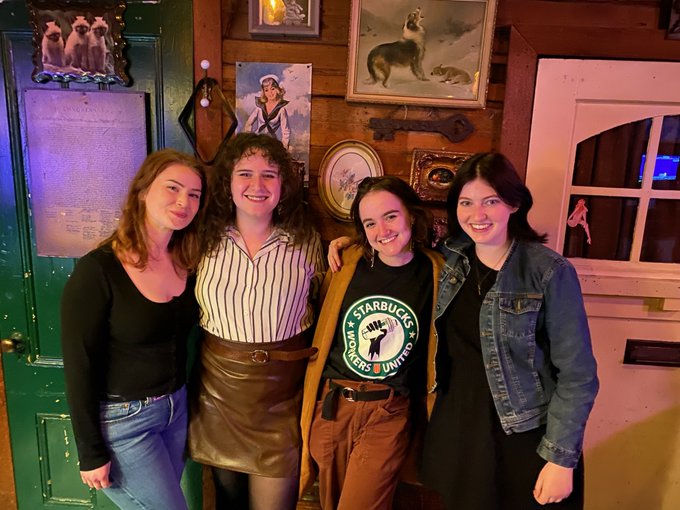
Partners at the 28th and Burnside Starbucks location in Portland voted
for their union this week and won big!

"You Belong" Outreach Campaign for Bias Response Hotline

From State Senator Floyd Prozanski:

Hate crimes and bias incidents are on the rise, both in Oregon and nationally. The Oregon Department of Justice Civil Rights Unit (CRU) has officially launched its "You Belong" campaign, a culturally and linguistically inclusive, statewide public outreach effort to increase awareness of Oregon's Bias Response Hotline as a crucial resource in the fight against the continued rise of hate crimes and bias incidents in Oregon.

It is up to all Oregonians to make sure that everyone is safe in our communities. Oregon's Bias Response Hotline is here to listen, support, and help. CRU's "Report and Support System" is designed to support victims and help track hate crimes and bias incidents. A key focus of this campaign is elevating the voices, faces, and experiences of real community members, and reflecting individual resilience, community strength, as well as resources available through the statewide Bias Response Hotline. The Hotline (1-844-924-BIAS/2427, StandAgainstHate.Oregon.gov) is the best place to report a hate crime or bias incident.

The Southern Workers Assembly And Some Questions For Readers

I sometimes take a simplistic approach to strategy and tactics. I put what I think out there when I tell people that I believe in what works. I often measure what might or might not be working by looking at the times and places where there are special difficulties. If your project works in a place wherte it is bound to meet some hard and thick walls, I'm interested. For those reasons I support the on-going Southern Workers Assembly and their Southern Worker Schools and I'm particularly interested in whether or not the models they're projecting can be adapated to conditions here in Oregon and elsewhere.

A recap of the most recent School on the Assembly's website leads off with this:

Southern politicians have gone out of their way in word and action to make clear they stand on the side of big business and racism as they’ve recently lamented that the “Alabama [ie – Southern] model for success is under attack” and vowing to “fight unions to the gates of hell.”

Nearly two hundred rank and filers who are developing a movement of workers in the South that can build power to make these politicians’ fears a reality gathered in Charlotte, NC on May 17 – 19 for the 2024 Southern Worker School. These convenings are the annual organizing conference of the Southern Workers Assembly network, which includes local workers assemblies, worker organizations, and other workers from various sectors and states throughout the region.

As the upsurge in worker organizing and fightback continues to expand – most notably represented in the UAW drives across the auto industry – the 2024 elections loom and the broader social movement to end the U.S. supported Israeli genocide in Palestine widens and spread, the gathering came at particularly timely juncture to assess conditions and develop united plans for advancing in this period.

“Being in a room with such a diverse group of workers, we can consider that a real cross section of the American landscape. It felt like a new beginning of the labor movement to me, a room filled with people organizing to achieve justice in the workplace, from all walks of life, to make sure we have justice for everyone regardless of race, gender, etc,” remarked Jamie Muhammad, Vice President of the International Longshoremen’s Association Local 1414 in Savannah, Georgia. “It was powerful, too, to see so many people wearing keffiyehs and showing solidarity with Palestine. Those are the type of people who look at the news and are aware of everyone’s suffering and want equality for everyone. I’ve never been in a room like that before. When the working people in the South rise up and we come together on a common cause, we can lead the rest of the nation where it needs to go.”

This was the largest worker school convened by the Southern Workers Assembly to date, and included delegations and participation from: El Futuro Es Nuestro/It’s Our Future; Siembra NC; United Campus Workers; UAW; ILA Local 1422; ILA Local 1414; Truckers Movement for Justice (TMJ); UE Local 150; UE Local 111; Union of Southern Service Workers (USSW); National Domestic Workers Alliance (NDWA); Carolina Amazonians United for Solidarity & Empowerment (CAUSE); Duke Graduate Students Union (DGSU); National Nurses United; and several locals of the International Brotherhood of Electrical Workers (IBEW), among others.


So right from the beginning here we're talking about people from many unions and backgrounds getting together under difficult political and economic conditions to talk and learn about things that matter and coming to the table prepared to struggle and make connections between their experiences as Southern workers with one another and with people in Palestine and elsewhere. 

You can see from the article that people showed up with a sophisticated understanding of how the world works. One speaker is quoted as reporting on the attempts to organize auto workers in the South and saying, "The Southern auto industry will not be organized one election at a time, nor will the hospital industry or logistics or any industry. We encourage other unions to follow their example. The UAW founding in the 1930s was based on sit-down strikes that were multi-corporation, multi-location efforts to organize the entire auto industry. That’s the way the modern labor movement was formed. And that’s the way the South will be organized today.”

We're going way beyond the comfort zones of most union trainings when the Assembly's report says

In light of these developments, the Southern Workers Assembly has recently launched a program aimed at recruiting workers to get jobs in some of these growing, strategic sectors of the Southern economy. This program was discussed in some detail during the weekend.

There was also a great deal of discussion of political power and how it’s developed, in light of the 2024 elections. The Southern Workers Assembly’s nine point Worker Power Program was raised as a way for workers to make independent political interventions that are connected to the primary objective of building organization and power in the workplace.

The report on the School makes for some quick and good reading. The Worker Power Program takes a bit more time and concentration. Please read the two documents together and consider how or if you can relate to what is being said there. If you can relate to that, my next question for you is if you think that this can be duplicated here in Oregon or elsewhere and to what extent that you think this could be done.

Portland State University American Association of University Professors is on the move!


Please join Portland State University-American Association of University Professors (PSU-AAUP) members for a union contract bargaining kickoff rally. Let’s come together to stop the cuts and win significant investments in PSU-AAUP’s working conditions which are student learning conditions!

An announcement from the PSU-AAUP website says "Across campus PSU-AAUP members continue to stage departmental meetings to get ready for bargaining the contract PSU-AAUP members and students deserve." 


Saturday, June 1, 2024

Save the Date: Webinar on Organizing, Collective Action, and the National Labor Relations Board


Please join the Economic Policy Institute (EPI) for a webinar on recent developments at the National Labor Relations Board (NLRB) and their impact on worker organizing.

NLRB General Counsel Jennifer Abruzzo will deliver opening remarks on the significant reforms her office has undertaken. A panel discussion about those reforms and their impact on workplace organizing will follow General Counsel Abruzzo's remarks.

The webinar will also discuss a recent EPI report that illustrates measures the NLRB has taken to support workers' organizing and bargaining rights under the Biden administration.

Featuring:
General Counsel Jennifer Abruzzo, National Labor Relations Board
Larry Cohen, Past President of the Communications Workers of America, Board Chair Our Revolution
Cindy Estrada, Strategic Advisor to the President for the Center for Transformational Organizing, AFL-CIO
Worker Organizer (TBD)
Lynn Rhinehart, Senior Fellow, Economic Policy Institute

Moderated by Samantha Sanders, Director of Government Affairs and Advocacy, Economic Policy Institute

Tuesday, June 11, 2024, 2:00–3:00 p.m. ET, 11:00 a.m.–12:00 p.m. PT

REGISTER: https://us06web.zoom.us/webinar/register/WN_3jqGZ93DTaWTmKUKnbM5dA